[Journey of Salt 07] The Quiet Battery Inside Every Cell
I. The Hospital Bed and the Simple Bag
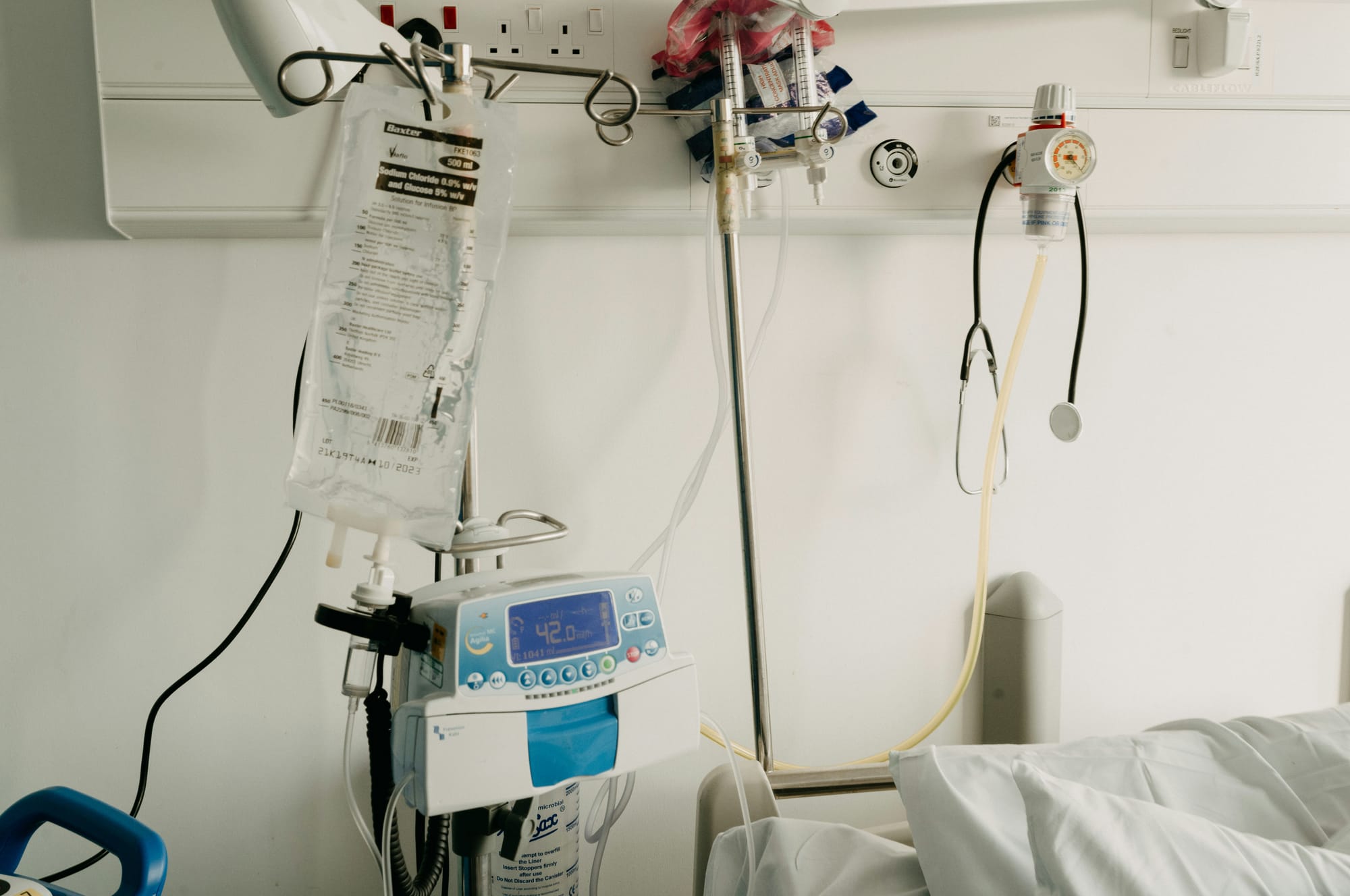
If you have ever visited an emergency room or stayed in a hospital bed, you have likely seen a clear plastic bag hanging from a metal stand. A thin tube runs down from that bag, delivering a steady drip of clear liquid directly into a patient’s vein.
Modern medicine has developed incredible therapies:
synthetic antibiotics, precision cancer treatments, and robotic surgery.
Yet, when a person arrives at a hospital with severe dehydration, acute trauma, or critical weakness, physicians almost always start with that clear liquid.
It is called 0.9% Normal Saline.
It is not plain distilled water.
If a doctor injected pure water directly into a patient's bloodstream, the result would be catastrophic. The red blood cells would rapidly absorb the water, swell beyond their physical limits, and burst open in a process known as hemolysis. To keep human blood cells stable, that fluid must contain roughly 9 grams of sodium chloride dissolved in a liter of purified water—about 0.3 ounces per quart.
In other words, the most immediate, life-saving intervention in modern clinical medicine is essentially salt water.
Many people spend decades viewing salt with worry, associating it almost entirely with high blood pressure and cardiac warnings. Yet, when our health drops to the absolute edge, modern medicine turns first to salt to keep the heart beating and the blood flowing.
Understanding why this is true requires taking a quiet look beneath our skin, where a vast electrical and fluid system works every second to keep us alive.
II. The Electrical Ocean Within Us
The human body is often described as roughly 70% water. For an adult weighing 160 pounds (approx. 73 kg), that means nearly 112 pounds of their total body weight is pure water.
This water does not sit loosely inside us like liquid in a bucket. It is carefully partitioned into two distinct physical spaces: the fluid inside our cells (intracellular fluid) and the fluid surrounding our cells, including our blood plasma (extracellular fluid).
In modern physiology, sodium is the dominant mineral holding that external fluid in place. Potassium sits primarily inside the cells, while sodium stays on the outside.
Every single cell in your body—from the neurons forming thoughts in your brain to the muscle fibers contracting in your legs—possesses a microscopic structure embedded in its outer membrane known as the Sodium-Potassium Pump (Na+/K+-ATPase).
This pump works constantly, twenty-four hours a day.
In fact, roughly 20% to 40% of all the resting metabolic energy you burn while sitting still on a chair is used solely to power these tiny cellular pumps.
What do they do?
They continuously push sodium ions out of the cell and pull potassium ions in.
Because of this constant mechanical work, the outside of your cell carries a slight positive charge, while the inside carries a slight negative charge. In medical science, this is called the membrane potential.
It is an electrical voltage difference of roughly negative 70 millivolts across a microscopic distance.
Your entire body is essentially made of trillions of tiny, charged rechargeable batteries.
When you decide to wiggle your toes, blink your eyes, or remember a childhood memory, your brain does not send an abstract magic signal. A gate in the cell membrane snaps open, and sodium rushes into the cell in a fraction of a millisecond. That sudden rush of sodium creates an electrical spike called an action potential.
Without sodium moving across that boundary, a nerve cannot fire.
A muscle fiber cannot contract.
The sinus node—the biological pacemaker inside your heart that keeps a steady pulse seventy times every minute—cannot initiate the electrical pulse that pumps blood to your lungs.
Salt is not merely a seasoning that makes food taste pleasant.
In western physiology, it is the elemental conductor that allows the human nervous system to operate.
![[Journey of Salt 06] Fused Salt](https://storage.ghost.io/c/8f/00/8f00fdb3-415c-42a4-a5c1-668df117e7f0/content/images/size/w750/2026/08/photo-1621315892013-f32af7358947-1.jpeg)
![[Journey of Salt 05] Salt Supports Digestion](https://storage.ghost.io/c/8f/00/8f00fdb3-415c-42a4-a5c1-668df117e7f0/content/images/size/w750/2026/08/photo-1569267575718-cc7287529e25-1.jpeg)
![[Journey of Salt 04] Nature's Masterpiece](https://storage.ghost.io/c/8f/00/8f00fdb3-415c-42a4-a5c1-668df117e7f0/content/images/size/w750/2026/08/photo-1677126120848-b839ce10f6ce-1.jpeg)
![[Journey of Salt 03] Where Modern Science and Ancient Wisdom Meet](https://storage.ghost.io/c/8f/00/8f00fdb3-415c-42a4-a5c1-668df117e7f0/content/images/size/w750/2026/08/photo-1659022679092-27b3ee7d8fdb-1.jpeg)
![[Journey of Salt 02] Sea Salt, Rock Salt, And...](https://storage.ghost.io/c/8f/00/8f00fdb3-415c-42a4-a5c1-668df117e7f0/content/images/size/w750/2026/08/photo-1604429295718-0b766e94cbd8-1.jpeg)